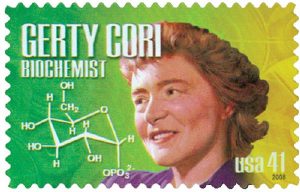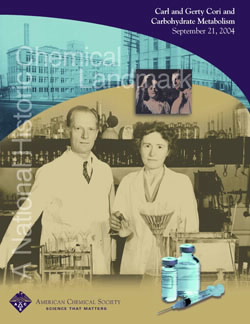
Carl Cori and Gerty Radnitz were both born in Prague, met in college, and married after receiving their graduate degrees. They eventually immigrated to the USA and did their prize-winning work as professors in the Pharmacology department, and later the Biological Chemistry department, at Washington University. They were cited by the Nobel committee for elucidating the pathway of glycogen synthesis and degradation, now known as the Cori cycle, which proceeds through a key intermediate α-D-glucose 1-phosphate, now known as the Cori ester.
Later in life, Gerty studied various glycogen storage diseases and discovered relationships to specific enzyme defects, in particular defects in glycogen debranching enzyme that result in irreversible buildup of glycogen with short outer branches, one form of which is called, you guessed it, Cori’s disease. After Gerty’s death, Carl pursued similar lines of work into clinical manifestations of glucose-6-phosphatase deficiency, called von Gierke’s disease (also a glycogen storage disease).